In my previous episode, I demonstrated and spoke in detail about many types of harnesses and collars that are available for your dog. Most of these tools have their distinct advantages and disadvantages. Depending on different factors such as the size of the dog, temperament, and physical attributes, these features can help determine the best walking tool for your particular dog.
Sometimes, there are dogs who need a little extra “reminder” from their handler to keep them focused and to correct unwanted behavior while out on a walk. In particular, a very common issue that dog owners experience while out in public is reactivity. Dogs are always going to have some kind of reaction to certain things they see on their walk, such as squirrels, loud noises, and other dogs.
The goal in training dogs is not to make them NOT have any reactions, but to teach them the impulse control to stay obedient to their handler during times of high excitement.
A lot of the times, dogs with mild reactions are fairly easy to manage, and their preferred walking tool of choice is very suitable. It’s when the dog is so reactive that none of the tools mentioned in my previous episode are effective enough.
For this specific episode, I will be referring to dogs who are reactive to the point of barking, growling and/or lunging and pulling on the leash so much that the handler cannot effectively manage and control the dog. That’s when I recommend a pinch (prong) collar. I only recommend using pinch collars when you are out and about walking your dog, not when you are correcting adverse behaviors in the house. I will also recommend a pinch collar for the client who really wants to walk their dog, but has some physical limitations and needs to be in the best control possible with their reactive dog.
“It's not a matter of creating this situation for the dog and letting him figure it out.” - Gary Flynn
The Herm Sprenger vs. imitation pinch collars
When I first started working at Petco in 2012, Herm Sprenger pinch collars were sold, but they were not allowed to be used for obedience classes. By the time I left in 2016, it was harder to find a Herm Sprenger collar because they were being replaced by cheaper versions made in China.
I have seen some imitation pinch collars where the prongs are very sharp to the touch. I would never put that on any dog. Also, the prongs were made out of a material that was very difficult to manipulate. I have even seen a prong collar with “SPRENGER'“ engraved on one of the end plates but not on the other plates. If you don’t know what a genuine Herm Sprenger pinch collar looks like, how would you be able to tell if it is an imitation? This is one of several reasons why you should seek a professional trainer before trying this collar out on your dog.
There are different kinds of Herm Sprenger pinch collars, One style is a quick release design that has a spring clip that can be attached to a chain depending on the tension required for a particular dog. This design makes it easier to get the best fit for a dog’s neck that is in between sizes.
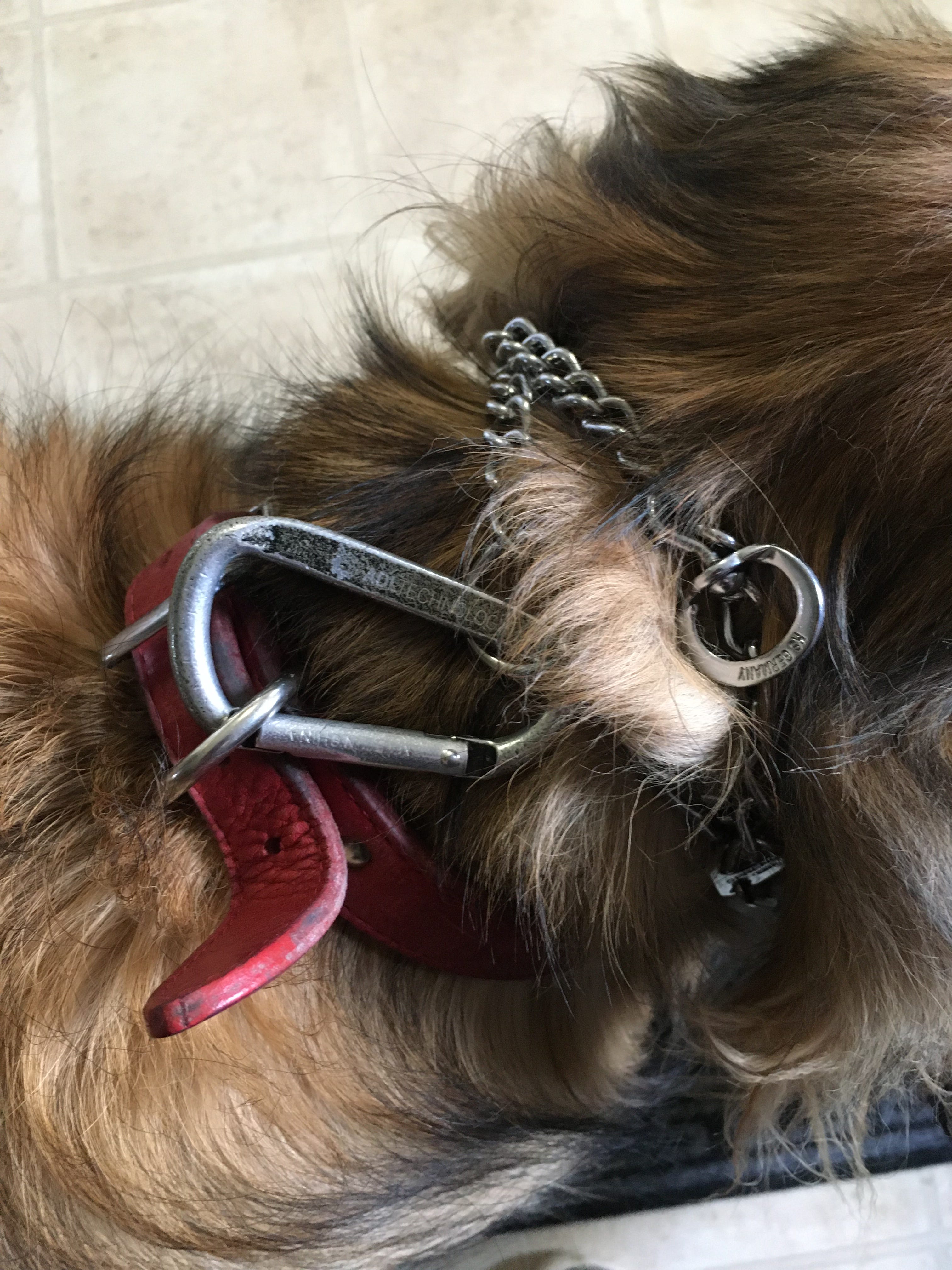
The other style is almost identical to the quick release except the spring clip is missing. Chain links replace the clip. The image of this type of pinch collar is below. Notice that the chain with the “D” ring is on top of the chain with the “O” ring. The leash is attached to the “D” ring and the carabiner clip is attached to the “O” ring of the buckle collar. The carabiner clip will keep you attached to your dog in the event the pinch collar should ever come apart. It is an insurance tool. It is rare that the collar comes apart, but there are many links that make up this collar that could come apart if they aren’t attached correctly.
I have also seen Herm Sprenger pinch collars online that attach using a plastic buckle clip. I believe this was designed for easier usage for the pet parent to remove and put on the collar. However, that clip will affect the exact pressure you are trying to achieve. Therefore, I don’t use them.
The Herm Sprenger is the pinch collar of choice
In my interview with Gary Flynn from The Dog Advocate in Vermilion, Ohio, we discuss how we use the pinch collar and when we recommend it. In Gary’s 38+ years of experience, he has used the Herm Sprenger prong collar exclusively. I also will not use any other collar but the Herm Sprenger. I have to add that Gary taught me how to use the pinch collar ever since I formed my own dog training company in 2017.
When Gary talks about a “finished dog” in the video, that means that he has exposed the dog to all kinds of stimuli at great distances for as long as he commands the dog to do so. He may train the dog on a pinch collar before introducing an electronic collar, depending on the level of training the client wants for their dog. For example, Gary may be hired to train a dog to be a protection dog. The way I show clients how to use a pinch collar is still appropriate, but Gary has to take the training to a totally different level than I would with a family dog. Gary’s “finished dogs” will obey him at a very reliable rate wearing no leash and no collar. This training doesn’t happen overnight. It doesn’t even happen in a few months. Depending on the temperament of the dog, the goal for a particular dog, and possibly having to decondition some inappropriate behaviors, this process can take up to a year or more. I highly recommend reading the episode from 2/11/25 entitled “Meet My Mentor and ‘Dog Trainer Friend’, Gary Flynn”. We talk about Gary’s experience as a dog handler.
Correct usage vs incorrect usage of pinch collars
The usage of the pinch collar must accompany or even follow training the pet parent how to properly manage their dog on a walk. The pinch collar alone will not be a magical fix so that the dog will walk perfectly for their handler in all situations. The dog has to learn how to behave during periods of high excitement and arousal. It is up to the handler to condition the dog so that they can remain calm, and surrender to the stimuli facing them. This is referred to as impulse control in the dog trainer world. If you leave the dog to make all the decisions, they will make dog decisions, which can possibly put everyone involved in danger. This is typically when clients contact a professional trainer. I don’t think I have met anyone yet who has successfully accomplished this conditioning on their own.
So many people will get a pinch collar when their dog becomes unruly on their walks. They are readily available in pet stores and online. My issue with this is, invariably, they will choose the wrong size collar, they will put it on the dog the wrong way, and they will fit it incorrectly. Gary demonstrates this in our video together. All of these factors can lead to injuries to the dog. This has led to a lot of backlash from the public and from veterinarians. Pinch collars are even banned in some countries.
I once saw a video on YouTube where a woman had an extra large pinch collar. She put it around her neck like a necklace and complained how dangerous it was. Of course this is dangerous. The links are too big and heavy, it probably wasn’t a Herm Sprenger, and they aren’t supposed to fit like necklaces. The largest size pinch collar I use is a Medium. Any larger than a Medium makes it a lot heavier and unnecessary for my client’s dogs. Gary may use a larger collar depending on the task at hand with his professional dogs.
Improper usage gives pinch collars a bad reputation.
I would like to clarify an argument that I hear in the dog world: Pinch collars are not part of the positive reinforcement philosophy. It is true that when I was trained to become a dog trainer at Petco, we were not allowed to use pinch collars in our obedience classes. They were sold in the store, but we were not able to use them.
When I look back at some of the dogs that were in my classes, I could have helped them so much more if I was allowed to use a pinch collar. People will stop taking their dogs out in public and stop taking their dog for daily walks because they can’t handle their dogs safely. They get to a point where they don’t even enjoy walking their dog anymore. Their frustration flows through the leash right to the dog. This conflict in energy just exacerbates the situation. Ultimately, the dog pays the price for this by not having an outlet for their energy. That is my ultimate motivator. I want dogs to get outside and be walked in a structured way. This leads to a more balanced dog with less issues in the home.
Testimonial from a client transitioning from a harness to a pinch collar
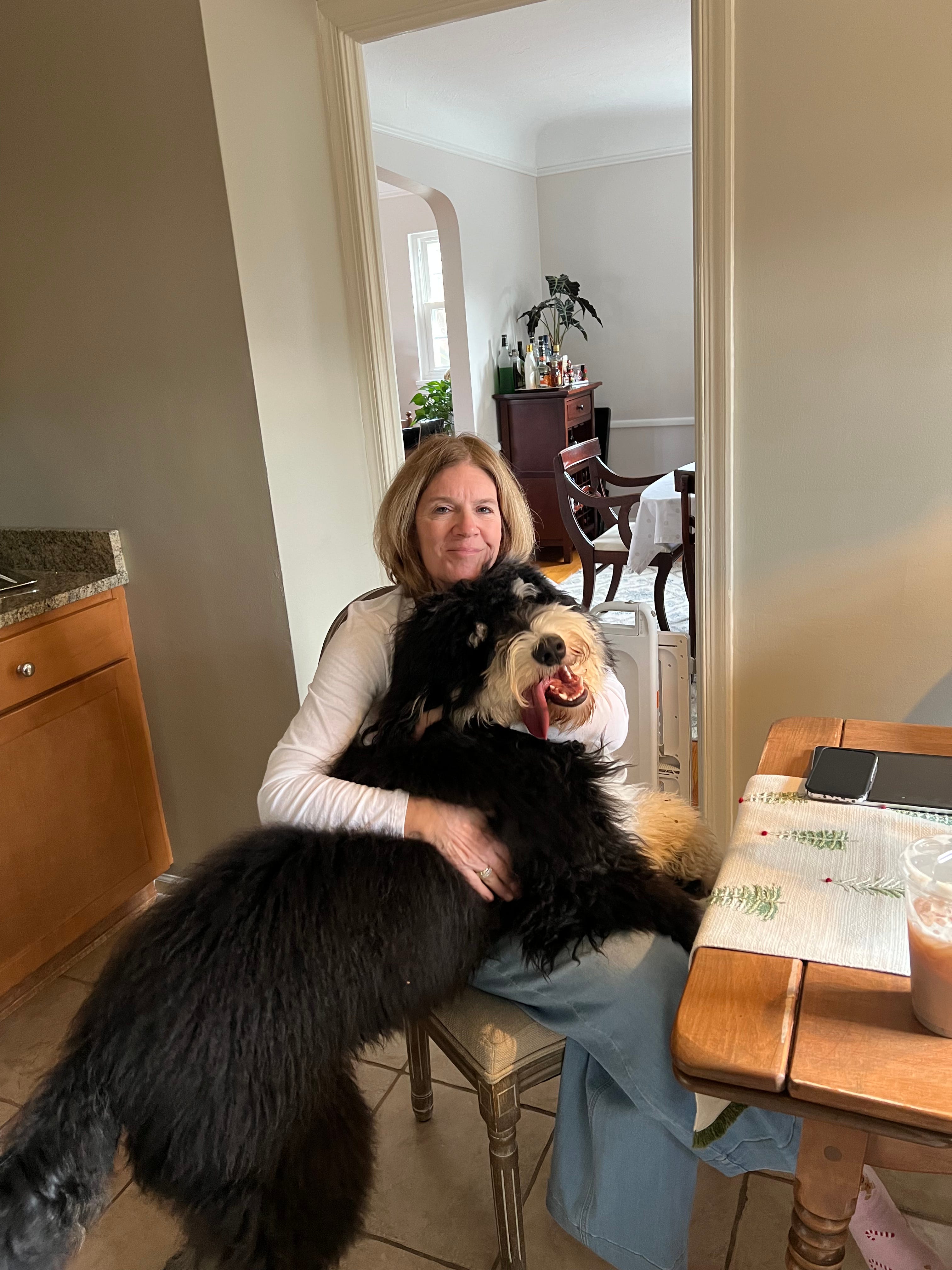
I have introduced pinch collars so many times now since I have had my own dog training business. They have been game changers. One client whose dog I recommended this collar to recently wrote me a testimonial, which is below. This client had no idea that her dog was going to be as big and powerful as he is now that he is full grown. Her testimony is as follows:
“The Herm Sprenger collar has been incredibly helpful in Clark’s training. I was admittedly apprehensive to use it. My motivation came out of frustration. I reached a point in training where I realized the Easy Walk harness was not working effectively. He is a high energy, large Bernedoodle and it was becoming very difficult for me to control him around people and other dogs. His response to the collar was immediate, after Susan worked with him. We have been using the Sprenger collar in conjunction with the Easy Walk Harness for this transition to prevent too many corrections during times of high excitement. It has been a couple of weeks now and his improvement is really noticeable. We definitely have more work to do, but I am hopeful he continues to learn and develop good boy behavior”. - Julie Tucci
Masterful design of the Herm Sprenger
Julie’s testimony is so on-point with the feedback I get from so many clients. First of all, let’s face it, the collar looks like a mideval torture device, but it does not hurt the dog. There is masterful engineering behind this design. It is designed so that all the points of pressure from each prong is evenly distributed. Even the way each prong folds is to increase skin tension and to effectively send a message to the dog that is attention getting without the intention of hurting the dog.
Does the pinch collar hurt the dog?
If clients are reluctant to try the collar because they think it will hurt the dog, I tell them to put it around their arm and pull down. Even on bare skin, this does not hurt. You can feel firsthand how it would feel around the dog’s neck. It’s a sensation, but it is not meant to hurt. If it is fit incorrectly, it can injure the dog. Studies have proven that a pinch collar that is properly fit and used correctly creates less trauma for the dog's neck than an improperly fit flat collar. The majority of the time, flat collars are fit way too loose. They fall down on the dog’s trachea which can get damaged by excessive tugging. Another reason to contact a professional dog trainer.
Corrections/”Pop”
The sensation from a quick tug, or a correction, on the leash is to redirect the dog back to paying attention to their handler and heeling by your side. It is not meant to be used as a punishment. We are not telling the dog “no”. We are simply putting up a guardrail that tells the dog to come back to its handler.
Sometimes the dog will end up correcting themselves. For example, if you are holding the leash fairly close to the clip of the leash and the dog quickly goes to try to smell something, they will feel that “pop”. They should resume their heel position (because that’s the alternate action you trained them to do after being corrected) and that’s when you praise them. When this happens again and they choose not to smell the ground because they know they will get that “pop”, reward the dog with treats and verbal praise for making a wise choice.
We refer to these quick tugs or “pops” as a correction. These corrections are to be accompanied by silence from the handler. It is not necessary to do these corrections with a lot of force. When I am teaching a client the technique of a correction, inevitably the client will slowly tug on the leash and hold the tension there before releasing the tension. This is exactly how I was when I was learning it too. I think it’s a natural reaction. However, dogs will get used to tension no matter how uncomfortable it is. All this does is create a tough neck which leads to the ineffectiveness of future corrections. Remember, as Gary Flynn has mentioned in previous episodes:
“If you are correcting more than you are directing, you are doing it backwards”.
Transition to a pinch collar
I always like to have a transition period from whichever tool the client had been using, to the prong collar. Not only does the client have to learn how to use the prong collar, but also the dog has to learn what they are supposed to do when they get a correction. Dogs will get used to constant pressure and constant tugs. We want to prevent this from happening. Since I want the correction to be effective and to mean something, I want to avoid having to correct the dog so many times while they are excited in certain situations. Therefore, I will introduce the collar in a very calm environment with very few distractions, like the client’s house. Then, as the dog progresses and understands what that correction means, we add more distractions to work through them in a calm way.
If a dog and client are starting out learning how to use a pinch collar in one of my group classes, I will have them attach the leash to what they are used to using, and also have the dog wearing the prong collar, while entering the training arena. The dog may be pulling so much because they are so excited to be there that we don’t want the prong to be less effective by having any sustained pressure or constant “pops” while managing this excitement. When I feel the dog has enough impulse control to assume the posture of the “sit by your side” during times of excitement, then we start using the prong collar full time.
Introducing the pinch collar
Gary and I both introduce the collar in the same way we introduce any tool that the dog is going to wear. This involves letting the dog smell it, look at it, and listen to it when it is moved. This collar has a lot of moving parts and makes more noise than most tools. We want to avoid any kind of noise aversion to the collar. We will even pet the dog with it in our hands. While using treats, and keeping this positive, depending on the dog’s reaction, we may quickly drape the collar over the nape of the neck and observe any adverse reactions.
If all is proceeding positively, we will size the collar to fit the dog’s neck. Pet parents are usually surprised at how tight the collar is when sized properly. Remember, too loose means possible injuries and ineffective corrections. Then we attach the collar and let the dog free range in the house or someplace with very few distractions. We are looking for signs of avoidance and not wanting to interact with us. This is actually very rare. Some very reactive dogs are actually very sensitive to how the pinch collar feels. I make sure I take my time with this type of dog and never rush the introduction process.
The majority of the time, the common reaction to the collar is a little itching around the neck. During this process, we are closely observing the dog’s behavior. I do this anyway whenever I introduce a dog to anything new, especially if he is going to wear it. These nuances in behavior can be missed by the untrained eye. This is why you should seek a professional trainer when introducing your dog to a pinch collar.
The next step, which actually may be a separate session with the dog and client, is to attach a leash. Again, I want to emphasize that this be done in an environment with very few distractions. You don’t want your dog darting out the door to get their own first correction. I will walk the dog around with no tension on the leash and then apply a little bit of constant pressure. When the dog breaks in the direction of the pressure, there is a huge reward of treats and verbal praise. I do this several times so that the dog is being conditioned how to turn off the pressure. At that point, I will be more specific about the place where I want the dog to be, which is in the heel position next to me. Dogs catch on very quickly to this concept. It’s truly amazing!
**As a side note, Gary uses a Biothane leash as seen in our podcast video. This type of leash holds up well under all weather conditions and is especially practical for doing long leash work. Cloth leashes that are 15’ long can wear down quickly after being dragged through the dirt and mud. Biothane leashes are waterproof and easy to clean. They are also very comfortable in your hands. These leashes are sold at Ray Allen Dog Supplies, Fairview Country Sales, Cabela’s, and J&J Dog Supplies.
Now that the leash is attached, I will go outside in the client’s driveway and work with the dog. I will introduce that quick tug or “pop” if the dog starts to go in a direction opposite from where I want him to go. There is no verbal command or sound during this process. Just action. The dog will remember that the pressure he initially felt means to come back to me in the heel position. I may correct him a few times to confirm and be very specific that this is the position I want him in. While I am working with the dog, I am continually giving him treats to reward every time he makes a wise decision and to also avoid the dog correcting himself so often because he is so excited. The last thing I will do is start changing direction and become very erratic with which direction I go. This just seals the deal for the dog to be in total follower mode.
Preloading the pinch collar
Gary and I discuss what it means to preload a quick release pinch collar. For dogs that are very intense in their reactions to stimuli, you can adjust the tension on the collar. If you “preload” the quick release collar, as I demonstrate in the video below, you will find that you won’t have to start off with as many corrections in order to achieve compliance from the dog.
Intentional/Unintentional corrections
Sometimes the dog will end up correcting themselves. For example, if you are holding the leash fairly close to the clip of the leash and the dog quickly lunges towards a squirrel, they will feel that “pop”. They should resume their heel position (because that’s the alternate action you trained them to do after being corrected) and that’s when you praise them. When this happens again and they choose not to lunge after a squirrel because they know they will get that “pop”, praise the dog for making a wise choice. However, let’s say your dog is eliminating somewhere you don’t want them to and you give them a correction while they are eliminating, the dog may think they are being corrected for eliminating. If this happens just one time, then no damage done. However, if the dog gets corrected inadvertently a few more times while eliminating, the dog may think they are doing something wrong and will stop eliminating on walks. As Gary says:
“The behaviors you shape intentionally or unintentionally are the behaviors you get.”
Training my dog, Ebi, on a pinch collar
Days after I got Ebi as a Leonberger puppy, I introduced her to a flat collar and leash. We walked out of the house, down the driveway, and went as far as two houses down before we returned back home. All along, I gave her treats when she stayed by my side and the leash was loose. We did this many times each day until I felt she was ready to go another couple of houses further. I taught her what the command “Heel” meant - right by my side with no tension on the leash.
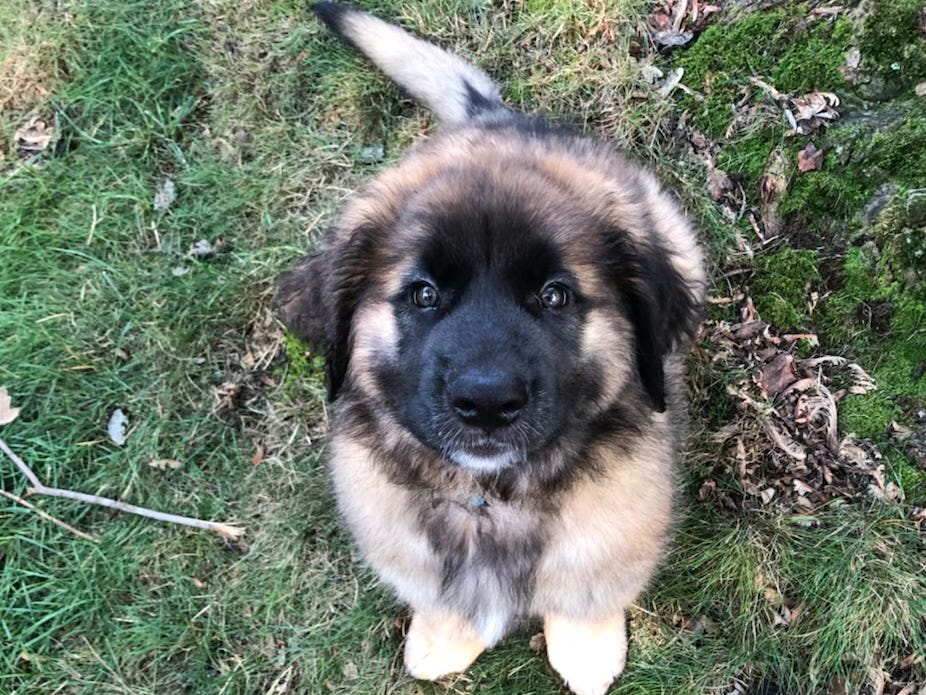
As Ebi grew, I introduced the Easy Walk harness. I continued my training with her, just as I described above, to reinforce the heel position. I knew that Ebi ultimately would weigh more than me. Since walking is so important, it was imperative that she become proficient in walking so that I could have the best control of her. When she had reactions to squirrels and other stimuli in the environment, I was able to correct her back into position until……. she weighed about 90lbs. My dream of exclusively using the Easy Walk harness was dashed. I knew that I could no longer manage Ebi and effectively teach her that I didn’t want her lunging after the squirrels. She was close to a year old at that point.
Then, Ebi went into heat at 15 months. I had been waiting for that day to come but didn’t know what symptoms to expect. Since Leonbergers are a giant breed, my vet, Dr. Randy at Animal Clinic Northview, highly recommended that she go through at least one heat cycle. This was around the time that Ebi didn’t want to be around any dogs. She lunged and barked at dogs in two different public places. This can be typical behavior for dogs going through a heat cycle. Now, I had this 100+ lb. dog who was starting to be reactive around other dogs. I no longer could use the Easy Walk harness and switched over to the pinch collar.
I noticed a new trait in Ebi. She was being a Leonberger and starting to bark to ward off strangers in her territory. Her bark changed. She was maturing. I worked through her reactivity by getting her to focus on me and taking away her job to protect her territory. When taking her on my pack walks, even though I walked her by my side, she felt her job was to protect the pack. I proved that by walking in the middle or back of the pack and she didn’t react when other dogs walked by.
Ebi still has reactive tendencies, but I have to work on my energy and not be so tense when I think she could have a reaction. This is difficult for me and for everyone out there with reactive dogs. You want to be prepared for a lunge, but you don’t want to tense up because the dog can feel your energy. That just adds fuel to the fire. The dog will sense that there is something to protect and will be on alert because you are on alert. I actually love to be able to transition a client’s dog back to a regular flat collar or slip collar when the dog’s reactivity is more manageable and has been drastically reduced.
The good news is that Ebi is so much better than she was. I had to stay with it even though working through her reactivity has been challenging. I would love to be able to walk her on a slip collar, but mentally I am not there. I know her strength and I don’t want to lose control in the event something causes her to lunge. I never would have been able to continue walking her for 7 years without a pinch collar. That’s a big reason why I am such an advocate for them. Ebi is a beautiful dog, inside and out. She is a well balanced dog due to her structured daily life with walks included in it.
My goal in explaining in detail so many nuances when using a pinch collar is to dispel a lot of the negative opinions out there about it. I have helped so many people who have been at their wits end trying to manage their dog just by introducing a pinch collar. They have even changed the way they feel about their dog. They have transformed from a place of utter frustration to actually enjoying their dog again. This is why I support introducing the pinch collar so much amidst all of the negativity surrounding it. To summarize the main points advocating the usage of the pinch collar, please refer to the training tips below.
Training tips when using a pinch collar
Contact a professional when introducing the collar
Make sure the collar is fit correctly
No tension on the leash (refer to the video below)
Never walk the dog in front of you
Be mindful of every correction and what you are correcting
Follow through by shaping the behavior you want; praise the dog
Start out teaching the dog with few distractions in the environment
Work your way up to increasing distractions while maintaining the heel position
Corrections should be a quick “pop” but not hard
I would love to hear your experience with a pinch collar and why you made the decision to use one. Please click on the ‘Leave a comment’ button below. Happy walking!